
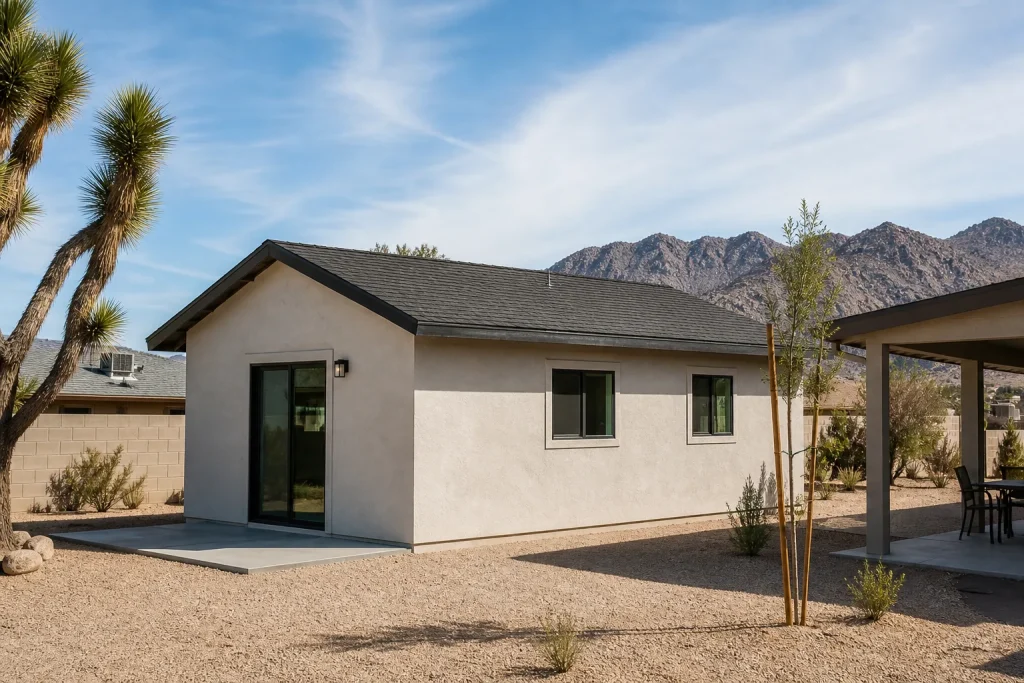
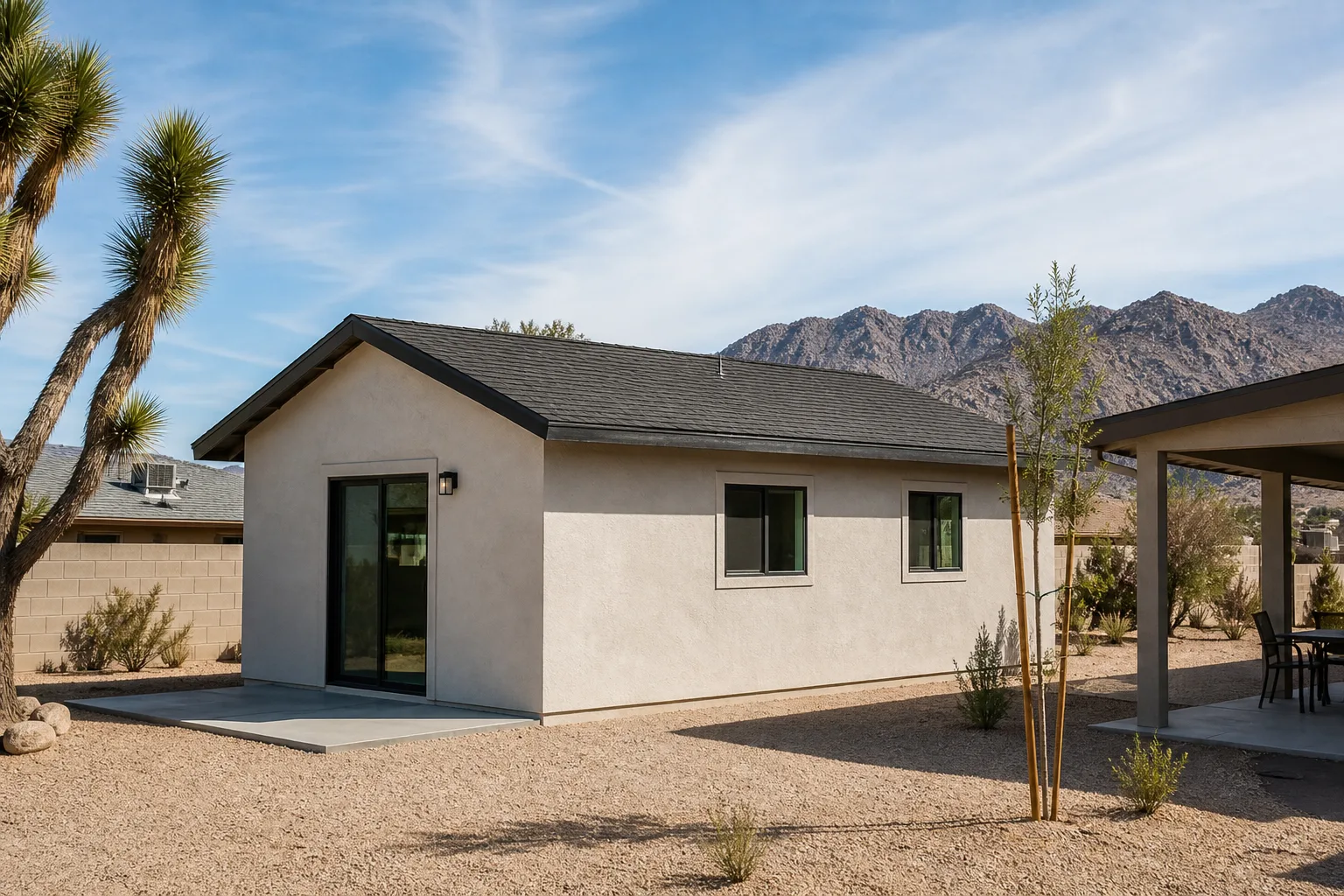
Cover ADU Builders in Apple Valley: A Homeowner’s Guide
Finding an ADU builder in Apple Valley who actually knows this market comes down to two things most homeowners never think to ask about: whether the contractor has an active working relationship with San Bernardino County plan checkers, and whether they have real subcontractor crews in the high desert rather than driving crews up the hill from down below. An ADU builder can show you a beautiful finished project in Rancho Cucamonga and still be completely unprepared for the permit desk at San Bernardino County’s Hesperia office, which is the specific point of contact that controls Apple Valley ADU approvals. If you’d rather skip the research and talk to a builder who already has those relationships, call (877) 265-9846 for a free estimate.
Why “We Build Throughout the Inland Empire” Isn’t the Same as Knowing Apple Valley
Plenty of ADU contractors list the entire Inland Empire as their service territory. That’s a marketing claim, not an operational reality. Apple Valley sits in San Bernardino County’s unincorporated high desert, and the building department that reviews your ADU plans is not the same one governing Rancho Cucamonga, Ontario, or Fontana. Those cities run their own permit desks with their own plan reviewers, their own interpretations of California ADU law, and their own correction cycles. When a builder says they work everywhere, ask them how many ADU permits they’ve actually pulled through the county’s Hesperia office specifically. That’s the office that processes Apple Valley applications.
In our experience reviewing projects across the high desert, plan check timelines at the county level run differently than city-level reviews. A builder who has sat in front of the same county reviewers multiple times understands which details get flagged: setback interpretations on larger lots, fire sprinkler requirements in Wildland-Urban Interface zones, and how the county handles detached versus attached ADU classifications on parcels with existing accessory structures. None of this shows up in a portfolio photo. It shows up in whether your permit gets approved in six weeks or six months.
The Three Questions That Reveal Whether a Builder Has Actually Pulled Permits in Apple Valley
Before you sign anything, sit down with any ADU builder and ask these three questions. A contractor who has genuinely worked in San Bernardino County’s unincorporated jurisdiction will answer without hesitation. A contractor who has only built in nearby incorporated cities will start hedging.
- “How many ADU permits have you pulled through the Hesperia building office in the last 24 months?” A real number, even a rough one, tells you they’ve been through the process recently. If they can’t name the Hesperia office at all, that’s your answer.
- “Which San Bernardino County plan checker has reviewed your Apple Valley ADU plans, and what did they typically flag?” This is the tell. Builders with county experience can describe recurring correction items, such as drainage calculations on sloped desert lots or solar readiness requirements. Builders faking it will give you a vague answer about “the process.”
- “Can you connect me with a past client in Apple Valley or the high desert whose project you completed in the last year?” If they’ve been working in this market, they have recent local references. If they point you to a project two hours away, they’re asking you to be their first high-desert experiment.
This is the part of vetting that most guides skip. Portfolio photos tell you about finish quality. These questions tell you whether the builder can actually get your project approved in Apple Valley’s specific regulatory environment.
Prefab ADU Builders vs. Site-Built: How Manufacturer Relationships Change Your Price and Timeline
You’ve probably noticed how crowded the prefab ADU market has become. Brands like Cover, Abodu, Dvele, Mighty Buildings, Boxabl, Plant Prefab, and Tuff Shed all advertise directly to homeowners. The pitch sounds similar: faster delivery, factory precision, predictable pricing. What the ads don’t tell you is that a builder’s access to these manufacturers, and the depth of that relationship, changes what you actually pay and when your unit actually arrives.
A builder locked to a single prefab brand has one inventory stream. When that manufacturer’s lead times stretch, which happens regularly in this market, your project stalls and there’s nothing the builder can do except wait. A builder with active relationships across multiple manufacturers can shift your order to whichever brand has production capacity and a floor plan that fits your lot. That’s not a marketing convenience. That’s schedule protection. We’ve seen orders with one manufacturer quoted at nine months while another brand had comparable units available in half that time. If your builder can only source from one, you inherit that delay.
The same logic applies to fit. Apple Valley lots vary enormously: some are flat desert parcels with easy crane access; others sit on slopes or have tight setbacks that make a modular delivery impractical. A builder who knows multiple construction formats, including panelized systems from Plant Prefab, 3D-printed structures from Mighty Buildings, shed-conversion approaches using Tuff Shed, and traditional stick-built construction, can recommend what actually works on your lot. A builder who only does site-built will push site-built even when a prefab would save you four months. A builder who only does prefab will push prefab even when your site conditions make delivery risky. The honest answer always starts with your specific parcel.
When you’re evaluating builders, ask how many manufacturers they can source from and which formats they’ve actually installed. The answer reveals whether you’re getting a real recommendation or a sales pitch for whatever they happen to have. Our position is simple: we match you to the right ADU product, not the one we happen to stock. Seven prefab brands, one site-built option. You pick what fits your lot and life.
Why Single-Contract Interior Finish Changes Your Risk Exposure
Most ADU projects get built in two phases that involve two different accountability chains. Phase one is the structure: foundation, framing or factory build, exterior cladding, roof, windows, and rough plumbing and electrical. Phase two is the interior: drywall, flooring, kitchen cabinets, bathroom tile, fixtures, and finish carpentry. With a typical general contractor arrangement, phase two goes to subcontractors the GC may or may not know well. When something goes wrong, the homeowner is stuck in the middle of a blame loop between the GC and the flooring sub or the cabinet installer.
A single-contract arrangement changes that dynamic. If the same company that erects the structure also has in-house crews for kitchen and bathroom finish work, there’s no hand-off to a third party. One contract, one accountable party, one point of contact when something needs fixing. That matters more in Apple Valley than in denser markets because the high desert has fewer finish trade specialists to begin with. The subcontractor pool is shallower, which means GCs sometimes import crews from down the hill, which adds travel cost and makes warranty follow-up slower.
Ask any builder you’re vetting who completes the interior of their ADUs. If the answer is “our subs,” ask which specific subs, where they’re based, and whether they’ve worked on the builder’s projects before. If the answer is “we have our own crews,” you’ve found a structural advantage. From foundation to finished kitchen, one team, one contract. That’s how you avoid becoming the project manager of your own ADU build.
How to Reference-Check an Apple Valley ADU Builder Like a Professional
Calling references is the step most homeowners do and do badly. They call one past client, hear “yeah, they were fine,” and check the box. That’s a wasted phone call. Here’s what to actually ask past clients in Apple Valley or nearby high-desert communities like Hesperia, Victorville, or Lucerne Valley:
- “What was your original promised completion date, and when did you actually get your certificate of occupancy?” Every builder misses dates occasionally. What you’re listening for is honesty about the misses and whether the builder communicated delays early or went silent.
- “When the builder hit site conditions they didn’t expect, like rock during excavation or winds that delayed craning, how did they handle the change order?” High-desert lots are full of surprises: decomposed granite, boulders, high wind days that shut down crane work. A builder who handled these transparently with a clear written change order is worth double whatever a builder with a cleaner looking portfolio charges.
- “Did they pull the permits themselves, and did anything on the final build deviate from what you signed?” This reveals whether the builder runs a disciplined permitting process or treats permits as an afterthought.
- “Would you hire them again if you built a second unit?” The only question that cuts through everything else. Listen to the pause before the answer.
We pulled one out of a garage over in the Sycamore Rocks area last year where the homeowner had signed with a builder who then kept pushing the start date back month after month. Turned out that builder had no local crews at all, he was bidding high-desert work and then hoping to find subs after signing. The homeowner eventually asked the right reference questions and walked away before losing more time. Schedule honesty and site-condition transparency are the two things reference calls reveal that nothing else will.
Evaluating Exterior Durability: Why Cladding Choice Matters More in the High Desert
Apple Valley gets extreme sun, high winds, freeze-thaw cycles in winter, and is surrounded by fire-prone terrain. Your ADU’s exterior cladding isn’t just aesthetic, it’s a durability and safety decision. Standard vinyl siding warps in high-desert heat. Wood lap siding requires constant repainting and performs questionably in wildfire ember exposure. Fiber-cement cladding solves both problems.
James Hardie fiber-cement products hold up to high UV exposure without fading or warping, resist rot and pest damage that plague wood exteriors, and carry fire-resistant properties that matter in San Bernardino County’s Wildland-Urban Interface zones. If you’re spending the money on an ADU in Apple Valley, specifying a fiber-cement exterior from the outset avoids a re-side job eight years in. Ask builders what exterior cladding they install and whether they have experience with James Hardie installation specifically. Installation matters, and incorrectly installed fiber cement voids the manufacturer warranty. Built tough outside with James Hardie, finished right inside with our own remodeling crews: that’s the specification we’d recommend to any Apple Valley homeowner.
Related services in Apple Valley: if you’re building an ADU and want the interior done by the same crew, see our kitchen remodeling and bathroom remodeling work. And if you’re looking at ADU builds elsewhere in the region, see ADU Builders in Loma Linda for how this plays out in a city-level jurisdiction.
Cover as an ADU Brand: Where It Fits in Apple Valley
Cover builds precision-engineered panelized ADUs with a focus on tight tolerances and fast on-site assembly. The system uses factory-cut steel framing and panelized wall systems that assemble quickly once the foundation is ready. For Apple Valley homeowners with flat, accessible lots and standard foundation conditions, Cover can be an excellent option: the assembly process reduces on-site framing time significantly, and the factory precision means fewer measurement errors than traditional stick-built.
But Cover has limitations that matter on certain Apple Valley parcels. Panelized systems still require a qualified local crew for foundation, assembly, and finishing. If your lot has significant slope, unusual setbacks, or ledge rock near the surface, a panelized system may need more site adaptation than a fully site-built approach. That’s not a criticism of Cover. It’s a reminder that no single brand fits every lot. The ADU market is crowded, and we’ve done the vetting so you don’t have to. A builder who can offer Cover alongside other manufacturers, and alongside site-built construction, is giving you a real comparison. A builder who can only offer Cover is giving you a sales pitch.
A note on 3D-printed and factory-built alternatives: Mighty Buildings 3D-prints panelized modules with reduced material waste and faster production cycles, and Boxabl produces factory-folded units with different trade-offs on ceiling height and customization. If you’re considering these approaches for an Apple Valley property, you want a builder with direct experience installing that specific system, because the on-site requirements differ meaningfully from traditional construction.
The Bottom Line
Choosing an ADU builder in Apple Valley comes down to four questions: Do they have active, recent experience with San Bernardino County’s Hesperia plan check office? Do they have local high-desert subcontractor relationships or, better yet, in-house crews? Can they source from multiple prefab manufacturers so your recommendation is driven by your lot and budget rather than their inventory? And will they finish the interior under the same contract that covers the structure? If the answer to all four is yes, you’ve found a builder who can actually deliver in this market. If you’re in Apple Valley and need help, Colonial ADU Builders home offers free estimates. Call (877) 265-9846 and we’ll walk your lot with you, talk through the options, and give you an honest recommendation.
Frequently Asked Questions
A detached ADU in Apple Valley typically runs anywhere from $180,000 to $450,000 depending on size, site conditions, and whether you go prefab or site-built. Prefab units can reduce labor cost but add factory delivery and crane fees on difficult lots. Site-built ADUs give you full design control but take longer and carry more variables. The only way to get an accurate number for your specific parcel is a site visit and a detailed estimate. Call (877) 265-9846 and we’ll walk your lot and give you a written line-item quote.
Yes. Every ADU in Apple Valley, whether prefab, panelized, 3D-printed, or site-built, requires permits through San Bernardino County’s building department, processed at the Hesperia office. The county reviews plans for setbacks, fire safety in Wildland-Urban Interface zones, drainage, and utility connections. A builder with recent county permit experience can move through this process faster than one learning the system on your project.
Realistic timelines run six to fourteen months from design to certificate of occupancy, depending on construction method and permit review speed. Prefab and panelized units compress on-site construction time but still require foundation work, utility connections, and interior finishing. Site-built ADUs typically run longer. The variable most homeowners underestimate is plan check time at the county level, which is why builder experience with the Hesperia office matters so much to your schedule.
It depends entirely on your lot. Flat parcels with easy access work well for prefab and panelized systems like those from Cover, Plant Prefab, or Mighty Buildings. Sloped lots, unusual setbacks, or difficult crane access often favor site-built construction. The right builder will evaluate your specific parcel and recommend what fits, rather than pushing whichever method they happen to sell. Call (877) 265-9846 for a free site evaluation and honest recommendation.
Written by the team at Colonial ADU Builders, serving Apple Valley since 2011.
Need ADU Help?
Call Colonial ADU Builders — licensed & insured, here with fast after-hours help in Loma Linda.
(877) 265-9846