
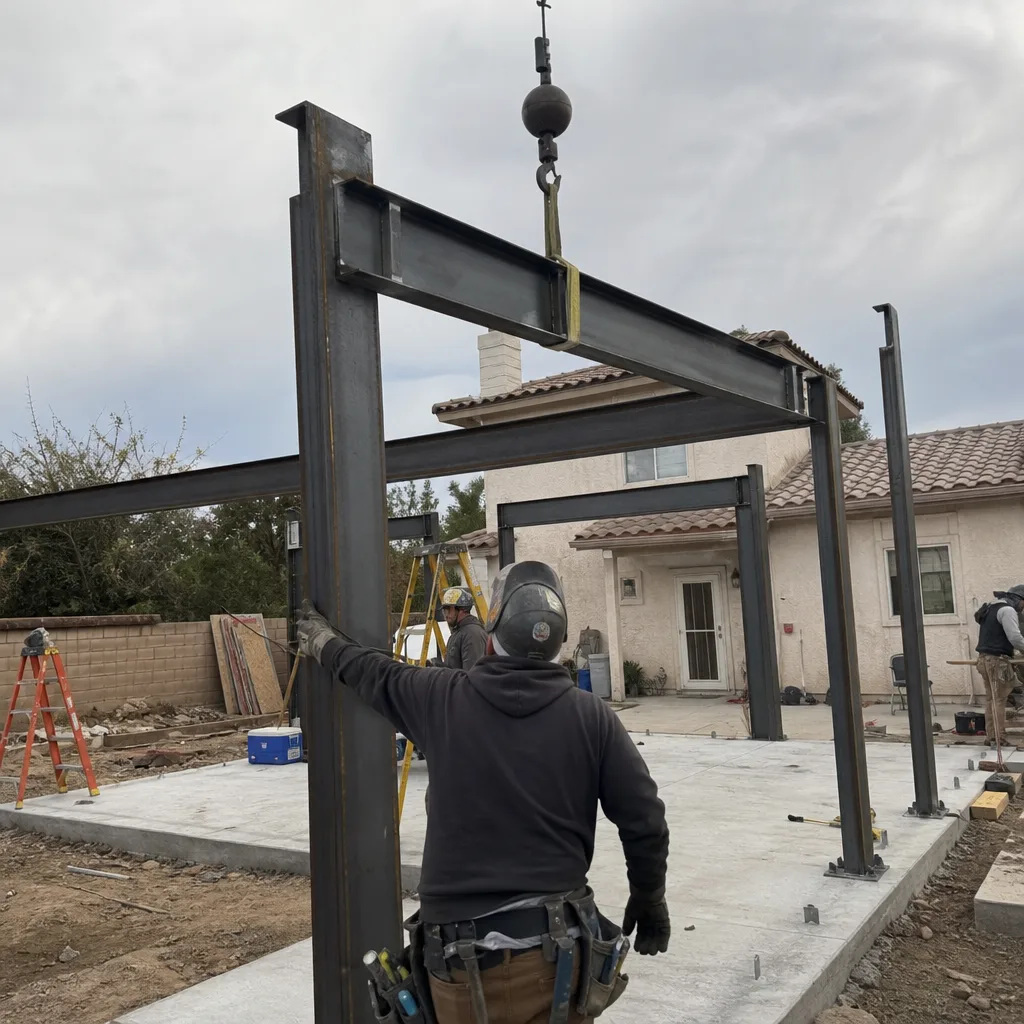
How Much Does ADU Site Prep & Utilities Cost in Apple Valley?
ADU site prep and utilities in Apple Valley typically run $18,000 to $55,000 for a detached unit, with most homeowners landing near $28,000 to $35,000 once grading, a utility trench, a new panel, and sewer or septic tie-ins are all included. That figure sits on top of the ADU structure itself, which is why the sitework line surprises people. Here’s the honest breakdown for the High Desert, with the numbers we see on actual Apple Valley lots.
If you’re mapping out the whole project, our home page lays out how sitework fits alongside structure, permits, and interior finish. This page stays focused on the ground under the unit and the services it needs.
Key Takeaways
- Typical all-in site prep and utilities for a detached Apple Valley ADU: $18,000 – $55,000.
- Utility trenching and the electrical panel are the two biggest line items, together often 40 – 50% of the total.
- Desert soil, caliche, and freeze-depth rules drive foundation and trench cost more here than in coastal markets.
- Septic versus sewer connection can swing the budget by $15,000 or more.
- Free estimates matter: (877) 265-9846. We quote sitework against your actual lot, not a national average.
ADU Site Prep & Utilities Cost Breakdown (2026)
These are real ranges for the Apple Valley market. Your lot will land somewhere in each band; a flat, served parcel sits at the low end and a raw lot on a slope with no sewer pushes the high end.
| Line item | Typical range (Apple Valley, 2026) | What it covers |
|---|---|---|
| Site survey & grading | $1,500 – $6,000 | Survey, cut and fill, erosion control, prep for the pad |
| SOG foundation / slab | $6,000 – $14,000 | Frost-protected slab, footings, termite and waterproofing detailing |
| Utility trenching (water, power, gas, sewer) | $5,000 – $14,000 | Excavation, pipe, conduit, backfill, inspection |
| Electrical service & panel upgrade | $3,500 – $9,000 | Meter tie-in, sub-panel or main panel upgrade, conduit run to ADU |
| Plumbing rough-in & tie-in | $2,500 – $7,500 | Water main tie, sewer lateral or septic connection, venting |
| Septic system (if no sewer) | $15,000 – $35,000 | Permit, tank, leach field, inspection – Apple Valley sees plenty of these |
| Gas line (if applicable) | $500 – $2,500 | Meter branch, trenched line, pressure test |
| Storm drainage / site drainage | $1,500 – $5,000 | Swales, drywells, downspout routing for desert flash rain |
| Driveway, walkway, pad extension | $3,000 – $12,000 | Access path for the unit, concrete or gravel |
What pushes the total up? Slope and caliche. Much of Apple Valley sits on a hard caliche layer that slows excavation and can force blasting or a bigger slab. A lot with no setback clearance, an old septic tank to abandon, or a long run to the utility easement all carry real cost. What brings it down? A flat, served parcel with an existing panel that has spare capacity, and a unit positioned close to the main house so trench runs stay short. Siting the ADU even ten feet closer to the service entry can save thousands in trench and conduit.
What Affects ADU Site Prep & Utilities Pricing in Apple Valley
Apple Valley isn’t a generic Southern California market. The desert, the lots, and the local rules all move the number.
- Soil and caliche. Sandy desert soil drains fast but often hides a cemented caliche layer. When we hit it during grading, excavation time and equipment cost climb. Locating it before you commit is the single best way to keep the foundation budget honest.
- Distance to existing utilities. The farther the ADU sits from the main house’s meter, panel, and sewer stub, the more trench and conduit you pay for. A 100-foot run versus a 30-foot run changes the electrical line item significantly.
- Septic versus sewer. Some Apple Valley parcels connect to public sewer; many rely on septic. A new septic system is the largest single swing item on this list, and it depends on soil percolation and lot size, not on the ADU’s size.
- Panel capacity. If the existing service panel has room, you save. If you need a new main panel or a service upgrade, that’s an added $3,500 – $9,000 plus utility coordination time.
- Freeze protection and slope. High Desert winter nights dip low enough to require frost-protected footings, and sloped lots need retaining or stepped grading, both of which add cost.
- Access and haul-off. Tight side yards or gates narrower than equipment mean smaller machines and more labor. A wide, clear path to the pad keeps the grading line lean.
Los Angeles County permitting and inspection timelines still apply here, and we build the sitework schedule around them. If you want a direct comparison to a neighboring market’s numbers, our ADU Site Prep & Utilities in Loma Linda guide breaks down how that area’s soil and utility patterns price out differently.
How to Save on ADU Site Prep & Utilities
Sitework isn’t where you want to cut corners, but there’s real room to trim without compromising the build.
- Survey first, before design. Knowing your setbacks, easements, and utility depths before you commit to a site prevents expensive redesigns later.
- Site the ADU near the main service. The closer the unit to your panel and sewer stub, the shorter the runs and the smaller the trench bill.
- Keep existing panel headroom. If you’re planning other projects, upgrading once is cheaper than twice. We can tell you how much capacity you actually have.
- Coordinate trenching with other sitework. One excavation pass that digs for water, power, gas, and sewer together costs less than four separate digs.
- Ask for a scoped, itemized sitework quote. A lump sum hides where the money goes. You want every line item priced.
We quote sitework against your actual lot, so call (877) 265-9846 for a free estimate and we’ll tell you where your parcel falls in the range.
FAQs – ADU Site Prep & Utilities Cost
How much does ADU site prep and utilities cost in Apple Valley?
Expect $18,000 to $55,000 for a detached ADU, with most projects near $28,000 – $35,000. The low end assumes a flat, sewer-served lot with panel capacity to spare; the high end reflects septic, slope, or sensitive soil. Call (877) 265-9846 for an exact figure on your lot – the estimate is free.
Can you come out today to look at my site?
Often, yes. Scheduling depends on our current route and the site’s access, so the fastest way to know is to call. Call (877) 265-9846 and we’ll tell you the soonest available slot for a walk-through of your lot.
Do I need a new electrical panel for an ADU?
Not always. If your current panel has spare capacity, you may only need a sub-panel and a conduit run, which runs roughly $3,500 – $5,000. A full service upgrade pushes that to $7,000 – $9,000. We evaluate capacity before quoting, so the number reflects what you actually need.
Is it cheaper to run utilities to a detached or attached ADU?
Attached ADUs are usually cheaper on utilities because the trench runs are short and you can often tap the existing service. Detached units cost more in trenching and pipe but give you more design freedom. The gap can be $8,000 – $15,000, so it’s worth comparing both before you commit.
Does Apple Valley require a separate septic system for an ADU?
Sometimes. It depends on your existing system’s capacity, the lot size, and local septic rules. If the current system can absorb the ADU’s load, you may only pay for a connection; if not, a new system runs $15,000 – $35,000. Call (877) 265-9846 and we’ll help you sort out which case you’re in before you budget.
Site prep and utilities are the ground truth of any ADU project, and getting them right up front is what keeps the rest of the build on schedule. From foundation to finished kitchen, one team and one contract – that’s how we keep the numbers honest. Call (877) 265-9846 for a free estimate, and let’s price your Apple Valley lot.
Pricing reflects the Apple Valley market as of 2026. Colonial ADU Builders offers free estimates – call (877) 265-9846.
What Our Customers Say
"Every invoice was tied to a completed milestone, so I always knew what I was paying for."
— Beatriz Mendoza"Garage conversion to a one bedroom unit. He handled the plans, the city submittal, and every round of corrections. Took six months from first meeting to final inspection and he never once made the permit process my problem."
— Christine Kim"Detached unit in the back yard. Utilities trenched, separate meter, and it passed final on the first inspection."
— Todd Rhodes