
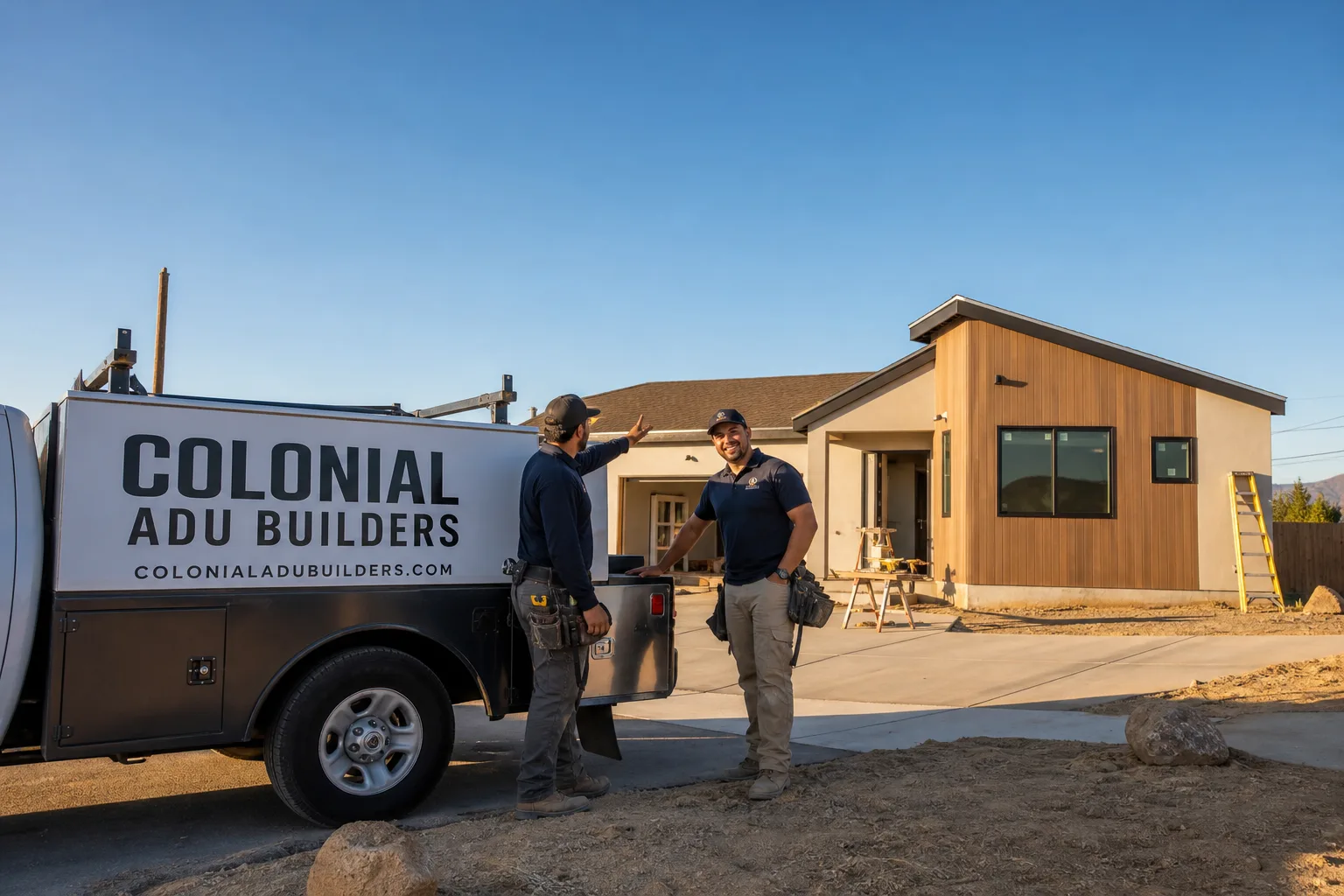
Fast, Reliable ADU Builders Across Redlands
Adding an ADU in Redlands typically costs between $180,000 and $450,000 depending on whether you go prefab or site-built, and most projects take 6 to 14 months from permit to final inspection. That’s the honest range we quote for Redlands specifically, where citrus-era lots, heritage trees, and newer HOA-governed subdivisions each create different planning realities. Colonial ADU Builders works throughout 92373, 92374, and 92375, and we know the difference between a Smiley Heights lot with a protected oak and a tract home off Sunset Drive with an HOA design review board. If you’re weighing your options, call (877) 265-9846 and we’ll walk you through what fits your property.
Why Colonial ADU Builders Is Redlands’s Preferred ADU Builders Company
We’re not a Redlands-based franchise or a distant operation that sends a sales rep and subcontracts everything out. Noel Carrasco leads our team, and he’s personally walked dozens of Redlands lots in the historic core, in South Redlands, and up in the newer developments around the 92374 corridor. That matters when a homeowner off Cajon Street needs to know whether their heritage tree root zone will force a different foundation type, or when a family in a builder-grade track home asks about warranty-safe utility tie-ins.
Our approach in Redlands is built on one consistent habit: we evaluate the lot first, the ADU product second. That’s why homeowners call us after getting confused by three different prefab sales pitches. We’ve built and installed units from multiple manufacturers, and we also do fully site-built construction. When a Redlands homeowner wants a detached unit behind a Craftsman bungalow, we can compare a panelized unit from Plant Prefab, a Dvele build, or a custom stick-built design and give them a straight answer about which makes sense on their specific lot. Most contractors only offer whichever method they’re set up for. We don’t have that constraint.
Backyard ADU in Redlands
A Backyard ADU in Redlands usually means a detached unit set behind the main house, and on the large citrus-era lots throughout the historic core, that’s often the smartest play. The mature trees that define neighborhoods off Cajon Street and around Smiley Heights are exactly the constraint flat subdivisions east of Redlands don’t deal with. You can’t trench through a heritage tree’s root zone without risking the tree and the permit. We map the roots first and site the ADU accordingly.
Siting Around Mature Trees
On a lot off Cajon Street near Smiley Heights, our crew set a detached backyard ADU back from the main house to protect a mature citrus tree’s root zone, then ran the utility trench around it rather than through it. This is standard practice for us in Redlands. Digging through a root zone doesn’t just kill the tree eventually; it destabilizes the soil under the new foundation.
Detached Unit Scope
A typical detached backyard ADU in Redlands runs $220,000 to $450,000 site-built, or $180,000 to $320,000 for a panelized or modular unit with utility connections and foundation work included. That includes the site plan, foundation, utility runs, erection, and interior finish. Heritage tree protection, if applicable, adds design time but rarely much hard cost once sited correctly.
ADU Construction in Redlands
ADU Construction in Redlands covers everything from a junior unit inside the existing footprint of a 1920s bungalow to a full detached build on a ranch lot in 92373. The construction method matters more here than in newer Inland Empire suburbs because the housing stock is so mixed: Spanish Revival homes with thick plaster walls, Craftsman bungalows with shallow crawlspaces, and 1990s through 2010s tract homes in the newer subdivisions. Each requires a different utility tie-in approach and panel reality.
Older Main-House Utilities
Much of Redlands is early-20th-century citrus-era housing stock, and that means older service panels, sewer laterals, and electrical systems on the main house. A detached ADU doesn’t fix those; it adds load. We plan the panel upgrade as a separate documented scope so a builder warranty on a newer main house stays intact, or so an older panel upgrade gets done before the ADU trench is backfilled.
Warranty-Safe Tie-Ins
When we build an ADU on a property with a newer builder-grade main home, we keep the utility tie-in documented and separate from the main structure’s warranty scope. Upgrading a panel or running a new sewer lateral without documentation is a fast way to void coverage. We hand the homeowner a scope sheet that shows what we touched, what we didn’t, and what the main house warranty still covers. That’s a level of care most ADU builders in this market skip.
Trusted Brands We Service in Redlands
We install and finish units from a vetted portfolio, and for Redlands homeowners the conversation often lands on Boxabl, Mighty Buildings, or Dvele depending on lot size, budget, and timeline. We don’t pick one and push it; we lay out the trade-offs. A Dvele unit brings a higher-end envelope suited to the Sierra-adjacent heat patterns. Boxabl fits tighter lots where a compact footprint makes sense. Mighty Buildings works when a panelized, precision-built shell shortens the site-time window. Our ADU Builders team handles specification, delivery, and finish work, so you’re not talking to a manufacturer’s rep one week and a stranger’s framing crew the next.
Common ADU Builders Problems We See in Redlands Homes
- Heritage tree root zones ignored during siting. A foundation or utility trench punched straight through a mature citrus tree’s root zone because nobody mapped the trees before design. The tree declines, the permit gets complicated, and the owner is left with a stressed landscape feature and a compromised root structure.
- Coastal build assumptions applied to Inland Empire heat. Undersized insulation, no deep overhangs, and windows placed without shade planning. The unit bakes in Redlands’ dry summer, and the owner’s cooling bill makes the ADU painful to operate six months a year.
- Builder-grade finish upgrades that void the main house warranty. A homeowner swaps out low-grade sliders or hollow-core doors in the ADU and ties the change into the main house’s panel or structural scope without documentation. The builder warranty gets voided, and suddenly the main house’s coverage is gone too.
- HOA architectural review missed until after design. A newer development in 92374 or 92375 has an HOA design review board that was never consulted before the ADU was drawn. The design gets rejected, the plan gets redrawn, and the homeowner pays twice.
Pricing for ADU Builders in Redlands, CA
A site-built detached ADU in Redlands runs $250,000 to $450,000 for a one-bedroom to two-bedroom unit with in-house interior finish. A prefab or panelized unit, installed and finished, lands between $180,000 and $320,000. A junior ADU inside the existing home footprint costs $80,000 to $150,000. What moves the number in Redlands specifically: lot access for equipment, heritage tree protection, panel upgrade scope, HOA design review fees, and whether the sewer lateral needs replacement. We give you a written line-item quote before you sign anything. Call (877) 265-9846 for a free estimate on your specific property.
We Also Serve Cities Near Redlands
Colonial ADU Builders handles projects throughout the surrounding area, including Mentone, Loma Linda, Highland, and Colton. If you’re in one of those cities and comparing ADU builders, the same honest, multi-brand approach applies. See our ADU Builders in Redlands page for local specifics, or call us directly for a property assessment.
Serving Redlands, CA — Our Local Coverage Area
We’re based in the Redlands area and know this community well. Use the map below to see our service coverage — if you’re nearby, we can almost certainly help.
FAQs About ADU Builders in Redlands
Upgrade the things that hurt you in Redlands’ summer heat first: insulation levels, deep overhangs or a covered patio, and low-E windows on the south and west elevations. Builder-grade hollow-core doors and standard low-grade sliders can wait; they’re cosmetic and easy to swap later. Call (877) 265-9846 and we’ll look at your unit’s orientation before you spend money.
Not if the work is scoped and documented correctly. The risk comes from tying new utility work into the main house’s systems without a separate scope and without documentation. We keep the ADU’s panel upgrade, sewer connection, and structural work on a separate scope sheet, so the main house warranty stays intact. That’s standard practice for us on every newer tract home in Redlands.
Yes, in most cases. The key is mapping the root zones before you finalize the siting plan, then running the utility trench around the protected area rather than through it. Heritage trees on lots off Cajon Street and in the Smiley Heights area often dictate where the foundation can go, but with the right site plan you keep the tree and the ADU.
In the newer subdivisions across 92374 and 92375, yes, often it does. Many HOAs in Redlands’ master-planned developments require design review before any detached structure goes in, and some restrict exterior materials or color palettes. We handle the submittal and know what those boards typically flag. Call (877) 265-9846 if you have your HOA’s CC&Rs and want a straight read on what’s likely to get approved.
Redlands sits east of the coastal fog belt, so the summer is dry and relentless. We plan for deeper overhangs, covered patios, higher insulation values, and window placement that minimizes western exposure. An ADU designed like a coastal build will bake. Call (877) 265-9846 if you want us to evaluate the orientation and shade plan on your lot before you commit to a design.
Written by Noel Carrasco, Owner at Colonial ADU Builders, serving Redlands and the surrounding Inland Empire.